By Poua Tajali
Today, the People’s Mojahedin Organization of Iran (MEK/PMOI) is known to many Western audiences as an Iranian opposition movement: a group that holds rallies and conferences in Europe and the United States, maintains ties with lawmakers and former government officials, and speaks of democracy, secularism, and human rights. But the history of the group began much earlier.
In the 1970s, the MEK was an underground, armed revolutionary group operating in Iran against the Shah’s government. During that period, American military personnel and U.S. civilians working on U.S.-related defense projects in Tehran were also targeted in its attacks. Years later, when the U.S. State Department removed the MEK from its list of Foreign Terrorist Organizations in 2012, it explicitly stated that the organization’s past terrorist activities—including its involvement in the killing of U.S. citizens in Iran in the 1970s—had not been forgotten. Therefore, this history is not merely a political allegation; it is part of the documented history of the U.S. government itself.
The central question is: How did a group with a documented history of violence against Americans become, decades later, an organization with political supporters and access to Washington?
The U.S. Congressional Research Service, in its historical assessment, also described the MEK as an anti-Shah group that emerged in the early 1960s and whose core ideology combined Islam and Marxism. The MEK was therefore not a conventional political party in the 1970s; it was an underground group that used violence against Iranian government targets as well as Western targets. Within this framework, the U.S. military and economic presence in Iran also became part of the organization’s targets.
Harold Price: The First American Target
On May 31, 1972, Brigadier General Harold L. Price of the U.S. Air Force, chief of the Air Force section of the U.S. Military Assistance Advisory Group in Tehran, was targeted in a bombing. The bomb had been planted along his usual route to work.
Price was seriously wounded, suffering, among other injuries, broken legs. An Iranian woman and a child were also killed in the explosion. The incident occurred at the same time as U.S. President Richard Nixon’s visit to Iran.
Price survived; the subsequent victims would not have the same opportunity…
Louis Hawkins: The Assassination of an American Officer
On June 2, 1973, Lieutenant Colonel Louis L. Hawkins of the U.S. Army, who was assigned to the U.S. Military Assistance Advisory Group in Tehran, was shot and killed. U.S. historical documents state that Hawkins was assassinated while walking from his residence toward the place where he was to board a vehicle.
The incident was significant because the victim was part of the U.S. military presence in Iran—a presence that the MEK regarded as part of the political order it opposed.
Shaffer and Turner: The Deadly Ambush of 1975

On May 21, 1975, Colonel Paul R. Shaffer Jr. and Lieutenant Colonel Jack H. Turner of the U.S. Air Force were assassinated in Tehran.
A declassified U.S. diplomatic cable provides a detailed account of the attack: one vehicle blocked their path while another approached them from behind. Three armed men got out, forced the Iranian driver to lie on the ground, and then shot Shaffer and Turner several times. A statement in both English and Persian was also left at the scene.

The U.S. State Department later explicitly identified the two officers as victims of MEK assassinations, and a government document stated that the organization had claimed responsibility for their killings.
Three Rockwell Employees: The 1976 Attack

On August 28, 1976, three American employees of Rockwell International were killed in Tehran:
- Donald J. Smith
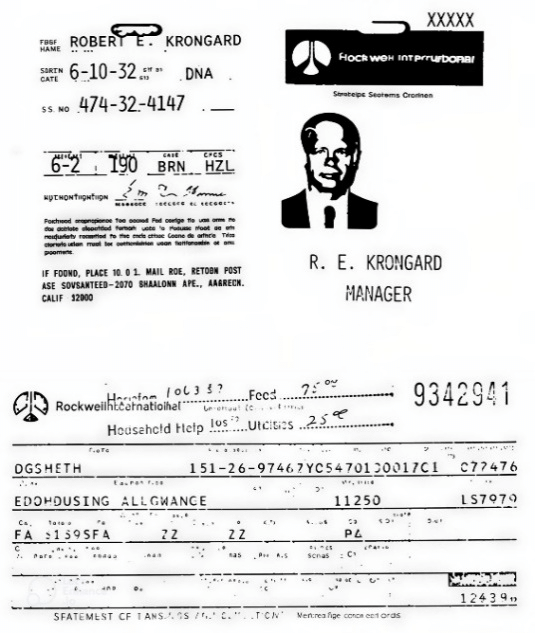
- Robert R. Krongard
- William C. Cottrell
They were working on an electronic research project related to the Iranian Air Force and were traveling toward Doshan Tappeh Air Base when they were ambushed.
According to a U.S. diplomatic document, a Volkswagen blocked their Dodge from the front, while a minibus blocked the road from behind. Four attackers then got out and opened fire. Cottrell was killed while attempting to leave the vehicle.
The Washington Post later reported that the three Rockwell employees working on the IBEX project had been killed; the project involved an electronic surveillance system associated with the Iranian military. The U.S. State Department also included this attack among the MEK’s attacks against American citizens.
Paul Grimm: The Seventh Victim
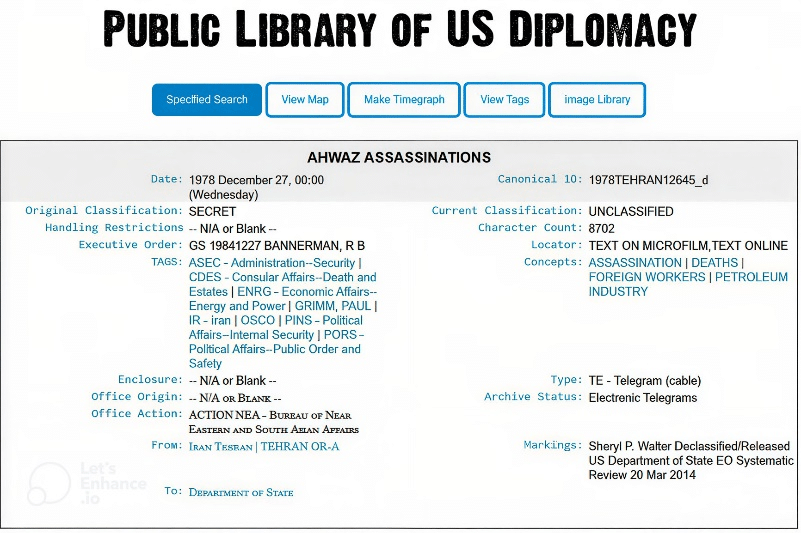
Paul Grimm, an American executive associated with Texaco, is the final case that is generally included in the overall U.S. government accounting.
An FBI declassified document states that in December 1978, MEK attackers shot and killed Grimm, who was a Texaco executive and the managing director of an Iranian oil-services company, while he was on his way to work.
Seven Victims; A Larger History
Behind the number “seven” are specific individuals:
- Louis Hawkins, an American military adviser;
- Paul Shaffer and Jack Turner, two U.S. Air Force officers;
- Donald Smith, Robert Krongard, and William Cottrell, three Rockwell International employees;
- and Paul Grimm, an American executive associated with Texaco.
But the organization’s history does not end with these seven individuals. Bombings targeting U.S. facilities, attacks against American companies, and the MEK’s alleged support for the seizure of the U.S. Embassy are also part of this history.
The issue, therefore, is not simply seven victims; it is the history of an organization that, at one point in its history, used violence against Americans as part of its revolutionary struggle.
In 1997, the United States designated the MEK as a Foreign Terrorist Organization (FTO), a status that remained in effect until September 28, 2012. The organization’s own history of violence was also part of Washington’s assessment in making that decision.
But in 2012, the situation changed. When announcing the organization’s removal from the list, the U.S. State Department said that the decision did not mean that its past terrorist activities were being ignored—including the MEK’s involvement in the killing of American citizens in Iran in the 1970s and an attack on U.S. soil in 1992.
This distinction is fundamental: A change in an organization’s legal status does not mean that its historical reality has changed.
This is where one of the most important historical contradictions emerges. Today, some American politicians and former U.S. government officials participate in events associated with the MEK. The Congressional Research Service has also referred to the continuing engagement of organizations associated with the MEK with members of Congress.
At the same time, the same U.S. government has preserved in its official records the history of the organization’s attacks against Americans.
This contradiction raises an important question for the American public: the MEK today may present itself using language different from that of the 1970s, but can a group simply render its violent past irrelevant? Are those who interact with or politically support the organization or its representatives in Washington aware of its history of attacks against American citizens? And if they are aware, what place does this history have in their decisions to cooperate with and provide political support to the organization?
On September 22 and 23, 2026, coinciding with the United Nations General Assembly meetings in New York, supporters of the movement known as the “Iranian Resistance” have called for a rally at Dag Hammarskjöld Plaza, outside the United Nations headquarters, and organizations including the Organization of Iranian American Communities (OIAC) are involved in promoting and organizing it.
Against this backdrop, the question becomes more relevant than ever:
If this history belonged to any other group, would Washington treat its past in the same way?